Table of Contents
ToggleYellow jackets are aggressive wasps that build nests in yards, attics, and walls, and they’ll defend their territory with a vengeance. Unlike honeybees, these striped insects don’t die after stinging, so one nest can deliver dozens of painful welts in minutes. If you’re searching for “yellow jacket pest control near me,” you might be dealing with an active infestation right now. The good news: some nests can be safely removed by a determined homeowner with the right approach, timing, and protective gear. This guide walks you through identifying the problem, removing nests yourself when it’s safe, and knowing when to call a professional.
Key Takeaways
- Yellow jackets are aggressive, multiple-stinging wasps that can house 500–5,000 workers per nest, making early detection and removal critical to prevent dangerous infestations near your home.
- DIY yellow jacket pest control near me is safe and effective for exposed, easily accessible nests when treated early morning or at dusk with aerosol insecticides and proper protective gear, but hidden nests in walls or attics require professional removal.
- Traps and bait stations work best as prevention in spring (April–May) to catch scouts or in late summer (August–September) during peak foraging, though they control populations rather than eliminate entire nests.
- Call a licensed pest control professional if nests are hidden in walls, attics, or ground burrows, if household members have wasp allergies, or if DIY treatments fail, with typical costs ranging from $200–$600 per nest.
- Preventing yellow jacket return requires sealing entry points, managing garbage with tight-fitting lids, eliminating rodent burrows and standing water, trimming vegetation, and installing early-season traps to intercept queens before nesting season begins.
Understanding Yellow Jackets and Why They’re a Problem
Yellow jackets are predatory wasps about the size of a honey bee, with distinctive black-and-yellow striped abdomens and a thin waist. Unlike many other wasps, yellow jackets are drawn to human food, garbage, and carrion, which is why they’re common at barbecues, picnics, and dumpsters.
They build papery nests from chewed wood fibers that can reach grapefruit size or larger. A single nest houses 500 to 5,000 workers, and they’re fiercely territorial. When you disturb a nest or get too close, guards swarm and sting repeatedly, injecting venom that causes sharp pain, swelling, and in rare cases, anaphylaxis in allergic people. Unlike honeybees, yellow jackets can sting multiple times without dying, making them especially dangerous near children and pets.
Yellow jackets also scavenge dead insects and rodents, so their presence signals a broader pest issue. Ignoring a nest rarely leads to abandonment: they expand and attract more colonies. Early action prevents a minor problem from becoming a major one.
Signs You Have a Yellow Jacket Infestation
Spotting yellow jackets early is key to safe removal. Watch for these warning signs:
Frequent sightings near food or trash. If you see yellow jackets buzzing around your garbage cans, recycling, or outdoor eating areas during late summer and fall, an active nest is likely nearby.
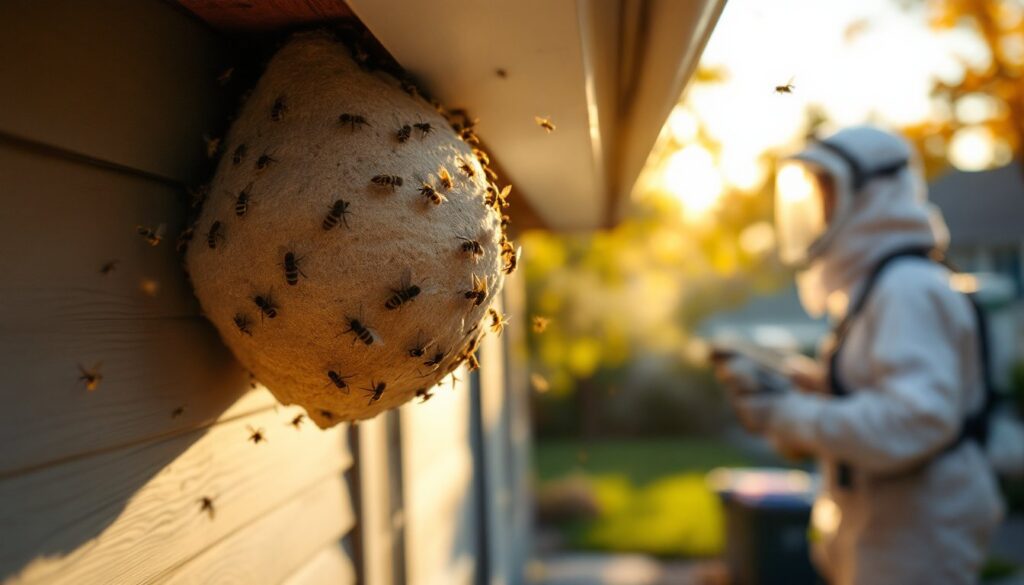
A papery nest in eaves, walls, or bushes. Yellow jacket nests look like upside-down teardrops made of gray, tan, or brown paper. Nests grow visibly week to week as the colony expands. Aerial nests (hanging from branches or eaves) are easier to treat than ground nests or wall cavities, which may require structural access.
Increased stinging incidents. Multiple stings on family members or pets in the same area suggest a defensive colony protecting a nest.
Loud humming or buzzing in walls. If you hear a dull roar from inside a wall cavity, a nest is likely hidden behind drywall or siding. This is a structural issue and may require professional removal.
Scout activity. In spring and early summer, single yellow jackets might explore your home, looking for nesting spots. Sealing cracks now prevents queens from establishing colonies later.
Don’t assume a single yellow jacket means a nest is nearby, they forage up to a quarter-mile from home. But repeated sightings in the same spot warrant investigation.
DIY Yellow Jacket Removal Methods That Actually Work
Traps and Bait Stations
Traps work best for small populations or as prevention before a nest establishes. Commercially available yellow jacket traps use sweet bait, pheromones, or protein attractants to lure wasps into a container from which they can’t escape. Hang traps 20 feet from seating areas, placing them too close just draws wasps to your patio.
Timing matters. Traps are most effective in late summer (August–September) when colonies are largest and workers roam further hunting protein. Spring traps (April–May) catch scouts before they nest. Set multiple traps in different areas and replace bait every 7–10 days. A single trap can catch dozens per day but won’t eliminate a nest: it’s damage control, not a cure.
Bait stations containing pesticide-laced protein attract foragers, who carry poison back to the nest. This takes 1–2 weeks and works only if workers return to the nest (some colonies are transient). Bait stations work better than traps for eliminating nests but require patience and the assumption that workers will share the poison with the queen.
Nest Removal and Treatment
If you’ve located the nest and it’s accessible (in an eave, on a branch, in a shrub), direct treatment is faster. Never attempt removal if the nest is in a wall cavity, chimney, attic space, or behind siding, you risk getting trapped with hundreds of angry wasps and missing queen cells that spawn new colonies.
Timing is crucial. Treat nests early morning (before 7 a.m.) or at dusk when most foragers are inside and flight activity is low. Wear full protective gear: a long-sleeved shirt, long pants tucked into socks, closed-toe boots, and a beekeeper’s veil or head net (not just a baseball cap). If your face is your largest target, protect it.
Dust or aerosol treatments are the standard approach for aerial nests. Products containing permethrin or pyrethrin (synthetic copy of a natural insecticide) kill wasps on contact. Apply aerosols from a safe distance (8–15 feet, depending on the product) in 2–3 short bursts directly at the nest opening. Don’t soak the nest or drench it: that wastes product and can cause it to rain down. Allow the product to dry or set for the time listed on the label (usually 30 minutes to 2 hours).
After treatment, leave the area and return in 24 hours to check activity. If wasps are still flying in and out, apply again. Once activity stops, you can physically remove the nest (it’s now a hollow paper shell) by placing a bag over it, carefully cutting the stalk, and sealing the bag. Dispose of it in sealed trash.
Do not use fire. Lighting a nest draws every wasp within visual range and risks burning your home or yourself. It’s reckless and ineffective.
Ground nests (in holes, rodent burrows, or under decks) require special care. These are often aggressive colonies. Use a dust formulation of insecticide puffed into the entrance hole at dusk. Seal the hole with a clod of soil or putty immediately after. If the nest is under a deck or shed, you may need to remove siding or decking, which is structural work best left to professionals.
Yellow jackets can re-nest in the same spot. After removal, caulk the area where the nest was attached or seal entry holes to deter returning queens.
When to Call a Professional Pest Control Service
DIY treatment works for exposed, easily accessible nests. But reach out to a licensed pest control professional if:
- The nest is in a wall cavity, attic, or hidden space. You can’t see the entire nest or safely apply treatment without demolition.
- Someone in your household is allergic to wasp venom. A single sting could be life-threatening: the risk isn’t worth a DIY attempt.
- Ground nests are large or aggressive. Multiple nests on your property suggest a serious infestation that warrants professional assessment.
- The nest is unreachable or risky to climb toward. Ladders, heights, and wasps are a deadly combo.
- Repeated DIY treatments failed. The queen survived, or satellite nests formed.
- You’re uncomfortable with it. Honestly, if you’re nervous about wasps, pay someone else to handle it.
Professional pest control services use stronger products, have proper equipment, and carry liability insurance. They can also address underlying attractions, garbage management, food scraps, rodent burrows, that draw wasps back. Services like Envirocon Pest Control and Tony’s Pest Control specialize in wasp and hornet removal and can handle nests in tough spots. Costs typically range from $200–$600 per nest depending on location and accessibility: consult HomeAdvisor for local pricing estimates.
Preventing Yellow Jackets From Returning
Prevention saves headaches (and stings) next year. Once nests are gone, use these strategies:
Seal entry points. Caulk gaps in siding, roof vents, soffit edges, and window frames where queens scout for nesting sites. Use silicone caulk rated for exterior use and apply in spring before nesting season.
Manage garbage and food. Keep trash cans in a sealed garage or bin with a tight-fitting lid. Rinse cans weekly to remove food residue. Don’t leave pet food outside, and clean up fallen fruit from trees. Yellow jackets love sugar and protein: reduce the buffet.
Remove water sources. Dripping hoses, stagnant birdbaths, and roof leaks attract wasps. Fix leaks promptly and refresh water sources every few days.
Eliminate rodent burrows. Yellow jackets nest in abandoned ground holes. Trap or exclude rodents, and fill burrows with soil or expanding foam.
Trim vegetation. Overgrown shrubs and tree branches near the house offer nesting spots. Prune branches 6–8 feet from the structure, and don’t let vines creep onto walls.
Install screens and exclude bees from eaves. Repair window and door screens, and use 1/8-inch hardware cloth to block soffit vents and eaves where nests commonly form.
Early-season traps (April–May) also intercept queens before nests establish. Hang several non-lethal or lethal traps and check them weekly. This proactive approach cuts the chance of a repeat infestation dramatically. Services like Crown Pest Control also offer preventive pest control plans that include regular monitoring and treatment to stop infestations before they start.